A Test Kit Reading Needs a Logbook
A water test result is easier to interpret when you can compare it with the tank’s recent history. Keep dates, methods and changes beside the readings, without treating a kit result as more precise than it is.
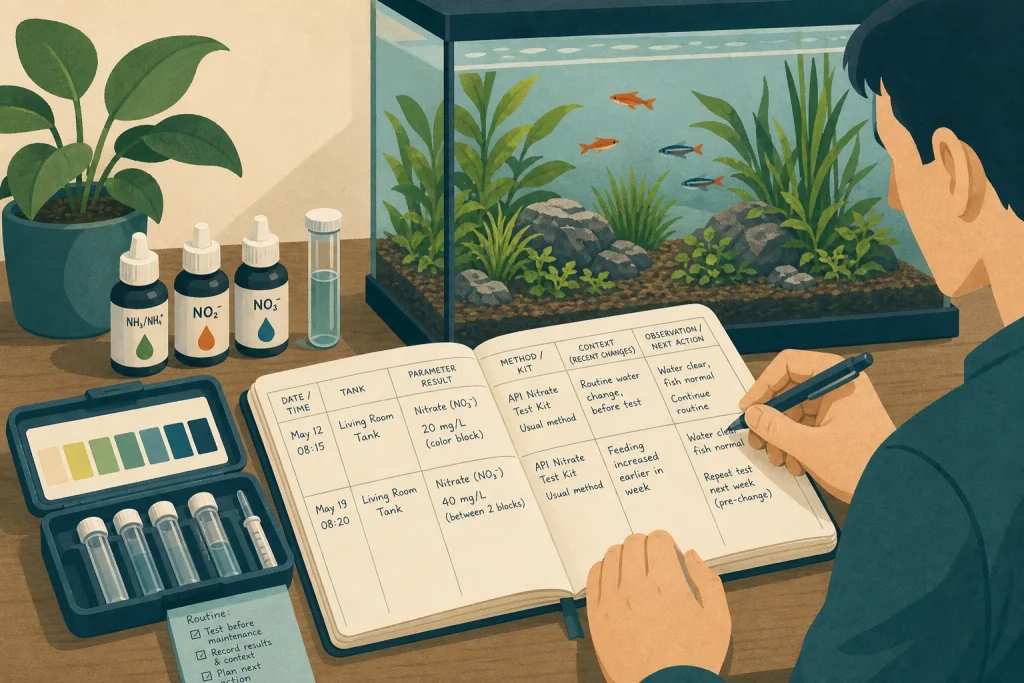
A test kit result belongs beside the date, the method and a note of what had recently changed in the tank. A result reported as zero means the kit showed no detectable amount under the conditions and limits described by its instructions; it does not establish that none was present. A log keeps that distinction visible and gives each reading useful context.
This need not be a formal scientific record. A notebook, spreadsheet or phone note will do, provided you can find entries later and understand what each one means. The aim is not to collect numbers for their own sake. It is to make the next sensible decision with a clearer picture of the aquarium.
What does a logbook add to a test result?
A test result is a snapshot of one sample, taken at one moment and interpreted using a particular method. By itself, it cannot show whether the result is usual for your tank, newly changed or part of a longer pattern. The kit’s instructions also matter: its colour scale, timing and stated limits shape what the result can tell you.
A water change, new fish, filter cleaning, medication or change in feeding may become relevant when you interpret a later result. So can the timing of the test. A reading taken before maintenance is not directly comparable with one taken afterwards unless you keep that difference in view.
A dated record helps you compare similar conditions and can discourage a rushed adjustment based on one unexpected colour. Check whether you followed the kit instructions, whether the tank had just been disturbed and what earlier entries say. Those checks do not settle what happened; they suggest a sensible next question.
Keep observations separate from explanations. “The ammonia test showed a higher colour block; feeding had increased earlier in the week” records two observations. “More feeding caused the result” makes a claim the log alone may not support.
What belongs in each entry?
For each test session, record the details that let you understand what the result represents:
- Date and time: Check when the sample was taken. If the entry is missing a time, add it while you still know it; if you are unsure, mark it as unknown rather than guessing.
- Tank identity: Check that the tank name is clear. If you keep several aquariums, use a consistent name or label; if you keep one, identify it by its location or another unambiguous name.
- Test and result: Check the parameter, the kit’s stated unit or scale, and the result as read from its instructions. If the colour sits between chart blocks, note that uncertainty; if it matches a block, record that reading without adding unsupported precision.
- Kit and method: Check which kit or test type you used and whether you followed its sample volume, timing and reagent sequence. If you changed kit or deviated from the instructions, record the change; if not, note that you used the usual method.
- Recent tank changes: Check for water changes, new livestock, filter work, medication or feeding changes. If an event occurred, note what it was and whether it came before or after the test; if none is relevant, write “no notable change” rather than leaving yourself to infer it later.
- Observation and next action: Check for visible changes in water or fish behaviour. If something unusual prompted the test, describe it plainly and state what you will check next; if nothing stood out, record that and continue your normal routine.
You do not need to describe every ordinary detail of aquarium care. Record events that could matter to the reading or to the decision you make from it. “Routine water change, before test” is more useful than a long account of an uneventful day.
A simple layout is “result”, “context” and “next action”. This keeps the kit’s indication distinct from your interpretation. If you later notice that the procedure differed from usual, you can revise your interpretation without losing the original entry.
How can you keep entries consistent?
Choose one place for the record and one routine for filling it in. Keep a notebook beside the test kit, or make a spreadsheet with columns for date, tank, parameter, result, method, context and next action. A record that is easy to update while the kit is in front of you is less likely to rely on memory.
Use the same units, result notation and tank names each time. For a colour-based kit, write the value shown by its chart rather than inventing extra precision. If the colour falls between blocks, say so. Follow the kit’s directions for sample volume, timing and reagent order, and record any departure.
Note conditions that help you compare readings, such as whether you tested before or after a water change. Add recent feeding or disturbance when it is relevant to the question you are trying to answer. Consistency matters more than a long list of details you will not keep recording.
Do not replace an unexpected result with a later reading that looks more plausible. Keep both entries, mark the second as a repeat and note why you repeated it. If you suspect a handling error, write that as a possibility rather than rewriting the first result.
How should you read a pattern?
Compare entries made under similar conditions. A pre-maintenance result is best compared with another pre-maintenance result where possible. If the kit or procedure changed, mark that clearly; a difference may reflect the method rather than a change in the aquarium.
Look for direction, repetition and timing rather than treating one number as a verdict. Ask whether the same parameter shifted again, whether a recorded event preceded the change, and whether a later reading moved back towards its earlier pattern. These questions can help you choose between repeating a test, checking your method or seeking knowledgeable advice.
A log can show that readings changed, but it cannot by itself prove why. Several events may have occurred close together, and the method has limits. Write “followed by” when that is all the record supports; reserve “caused by” for a conclusion supported by more than timing alone.
Say you keep a planted community tank. Before a routine water change, you record the nitrate result using the same kit and method as usual. Later, you test again and record a different colour reading; your notes also show that feeding changed earlier in the week. The entries do not tell you which event accounts for the difference. Your next decision is to keep the next test at a comparable point in the maintenance routine and record whether the difference persists, rather than changing several things at once.
Which changes are worth recording?
Record changes that could affect water conditions, the test or your interpretation of animal behaviour. For a water change, note that it happened and whether it came before or after testing; if the replacement water source differed from usual, add that detail. For filter work, distinguish routine rinsing from replacing media or making a substantial change.
Note new livestock, losses, medication and major feeding changes. In a planted tank, a change in fertiliser routine or substantial plant trimming may be relevant. A sudden change in water appearance or unusual fish behaviour belongs in the record, especially if it prompted a test.
There is little value in logging every small maintenance gesture if it has no bearing on a question you are following. Wiping the glass need not become an entry unless it coincided with an unusual observation or change. The record should preserve useful context, not turn aquarium keeping into paperwork.
What is not worth the effort?
Elaborate descriptions of every test rarely help when a short, consistent entry will do. Nor is it helpful to copy the same result into several places, where versions can drift apart. Pick one main record and make it easy to update.
A decorative chart is not a substitute for clear notes. If a graph hides the test method, timing or maintenance event, it can make a record look more certain than it is. Add a chart only if repeated entries make a pattern hard to see; a plain table or notebook is enough to begin.
Avoid false precision. A colour-based kit does not become more exact because you write extra digits. If you fill in a missing detail later, mark it as recalled; if you cannot recall it, “not recorded” is more honest than a guess.
When should the log prompt a next step?
If a result is unexpected, check the kit instructions, expiry information and your handling of the sample. If the instructions allow a repeat, use a fresh sample and record both readings; if the repeat differs, retain both entries and consider what could explain the difference rather than discarding the first result.
If results repeatedly fall outside guidance for the fish and setup, or livestock show concerning changes, seek advice from a knowledgeable aquarist or an aquatic veterinarian. A log can make that conversation clearer by showing the sequence of readings, maintenance and observations. It cannot replace professional advice when animals appear unwell.
Write down the next action, even if it is simply “repeat using the same method” or “test again before the next routine change”. That note turns a number into a useful reminder. A modest logbook cannot make every cause obvious, but it can help you notice what changed and respond with less guesswork.