What Filter Media Does Before Water Returns to the Tank
Mechanical, biological and chemical media each alter the water in a different way. Understanding those roles makes filter layout and maintenance easier to judge.
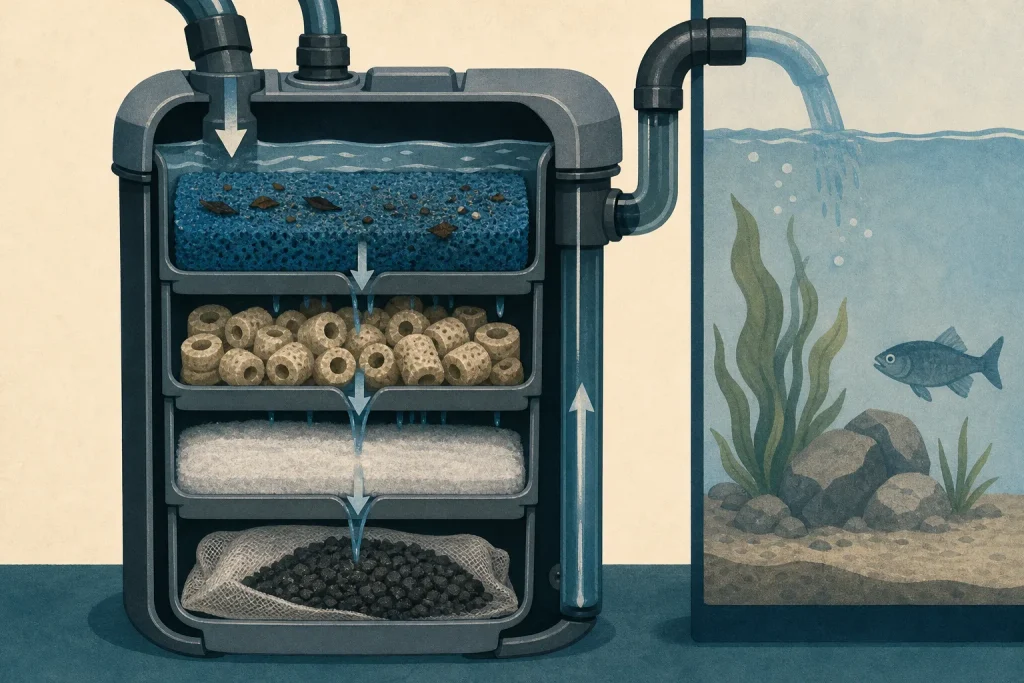
A filter works best when water reaches each medium in a useful order. Coarse debris should meet an accessible mechanical layer first, while biological media needs a steady supply of oxygenated water. Chemical media has a narrower, product-specific role. The filter’s own flow path matters more than a universal arrangement.
What should catch debris first?
Mechanical media traps particles carried into the filter: uneaten food, plant fragments, fish waste and suspended detritus. Coarse sponge, foam blocks, filter floss and purpose-made pads all do this job. They hold debris until you clean or replace them.
Put the coarsest layer where incoming water reaches it first. It can catch larger pieces without quickly blocking the route to later stages. Finer floss can follow if you need to capture smaller particles and the filter can maintain good flow through it. A tightly packed fine pad may restrict circulation, so inspect for clogging if the output weakens.
Mechanical media often needs attention before biological media because it collects visible waste. Rinse reusable sponge in water removed from the aquarium during a water change, or follow the filter maker’s instructions for that material. Aquarium water is a gentle cleaning option, but it is not the only acceptable method: some media and filter designs have specific care instructions. If you use tap water, consider the local water treatment and the maker’s guidance, since disinfectants such as chlorine or chloramine can affect established bacteria. Replace disposable pads when they are clogged or falling apart, and avoid discarding every part of a mature filter at once.
How should biological media be treated?
Biological media provides surfaces for beneficial bacteria that help process fish waste, including ammonia, as part of the aquarium’s nitrogen cycle. Ceramic rings, porous blocks, sintered media and sponge can all serve this purpose. The material matters less than keeping it wet and supplied with oxygenated water.
Biological media usually belongs after coarse mechanical media, so large debris is less likely to coat its surfaces. It still needs a reliable path for water to pass through. A basket packed so tightly that water bypasses the media will not serve the filter well.
Do not scrub established biological media until it looks new. If it needs rinsing because flow has slowed, use removed aquarium water or follow the maker’s care instructions, and handle it gently. Replacing all the media together can remove much of the filter’s bacterial colony. When changing filter types or rearranging media, keep mature media wet and running if possible, make changes gradually, and monitor water quality.
When is chemical media useful?
Chemical media changes water through adsorption or another material-specific process. Activated carbon can remove some dissolved compounds, including residues from certain treatments. Other products target particular substances, such as phosphate or ammonia. These products are not interchangeable, so check the packaging for the intended use and any limits.
Treat chemical media as a tool for a defined need, not a required layer in every filter. During medication, carbon may remove the treatment; follow the treatment instructions about whether to take it out and when to put it back. Afterward, carbon may help remove residues, but a water change may also be part of the care plan.
Place chemical media after mechanical filtration so trapped debris does not coat it unnecessarily. Use the supplied bag or a suitable media basket, and leave room for water to pass through rather than around it. Replace or remove the media in line with its purpose and instructions. Unlike a sponge, it generally cannot be judged by how dirty it looks.
How can you follow the filter’s water path?
Follow the maker’s diagram first. Identify where water enters, how it moves through compartments and where it returns to the tank. A common sequence is coarse mechanical media, finer mechanical media if needed, biological media, then any chemical media being used—but the physical arrangement varies between canister, hang-on-back and internal filters.
Some filters draw water from the bottom and send it upwards; others route it across trays or through a cartridge. Check that baskets sit correctly and that gaps do not let most water bypass the media. Keep the intake and outlet clear. Do not wedge material into a space intended to carry water.
Say your canister’s manual shows water entering the lowest tray and travelling upwards. The starting arrangement is an empty filter and a bag of carbon intended for clearing treatment residue. Put coarse sponge in the lowest tray, biological media in the next, and the carbon bag in an upper tray, leaving the specified flow spaces clear. Reassemble and prime the filter as directed, then check that water returns normally and the basket is seated. The resulting decision is straightforward: if the flow path matches the diagram and water moves through the media, keep that arrangement; if the manual shows a different route or flow is obstructed, reposition the media according to the diagram rather than forcing this sequence.
What should you check before changing the layout?
- Water path: Check the manual’s arrows or diagram. If the proposed order follows the documented route, use it; if not, arrange the media to match the filter design.
- Mechanical layer: Check whether coarse sponge is catching visible debris and whether the filter still has clear flow. If debris is accumulating and output is normal, continue routine checks; if output weakens, clean the sponge according to its care instructions.
- Fine pad: Check whether floss or a fine pad is clogged or compressed. If water passes freely, keep it in place; if it restricts flow, clean or replace it as directed, or remove it if the filter does not need that finer stage.
- Biological media: Check that it stays wet, receives water and is not being bypassed. If it is in the water path, leave it undisturbed; if it is dry or bypassed, correct the placement while preserving mature media.
- Chemical media: Check the product’s stated purpose against the current need. If it matches, use it as directed; if there is no defined need or the product conflicts with a treatment, remove it or follow the treatment instructions.
- Basket fit: Check that trays and cartridges sit as the maker intends and do not block the intake or outlet. If they fit and water can pass, run the filter; if a gap or obstruction is diverting flow, reseat the parts before restarting.
- Cleaning method: Check the media label or filter instructions for rinsing guidance. If they specify a method, follow it; if they do not, aquarium water removed during a water change is a cautious option for reusable media, while badly worn disposable material should be replaced.
How much cleaning is enough?
Clean one section at a time where the filter design allows it. This leaves other surfaces undisturbed and reduces the chance of removing too much established biological material in one maintenance session. Reassemble the filter as intended, prime it if required, and confirm that water is moving normally before leaving it to run.
There is little value in stacking every media type into a small filter simply because there is room. Extra layers can impede flow, make maintenance awkward or duplicate a job the filter does not need. Start with the maker’s recommended arrangement, keep biological media stable, and add specialist media only when there is a clear reason.
What does weak flow tell you?
A useful layout keeps water moving through the media and makes routine cleaning manageable. If output weakens, inspect clogged mechanical media, a blocked intake and an incorrectly seated basket before assuming biological media needs replacing. If you add a new product, check that it fits the filter and does not obstruct the normal route.
When a filter is crowded, simplify rather than compressing everything into place. Preserve established biological media, make the first mechanical stage easy to access, and keep chemical media removable. Those choices make it easier to identify what needs attention when flow changes or a specific treatment need arises.