Before Adding a New Fish, Trace the Tankmate Question
Compatibility is more than whether fish seem peaceful at the shop. Compare adult size, swimming space, social needs and habitat before deciding which tankmates belong together.
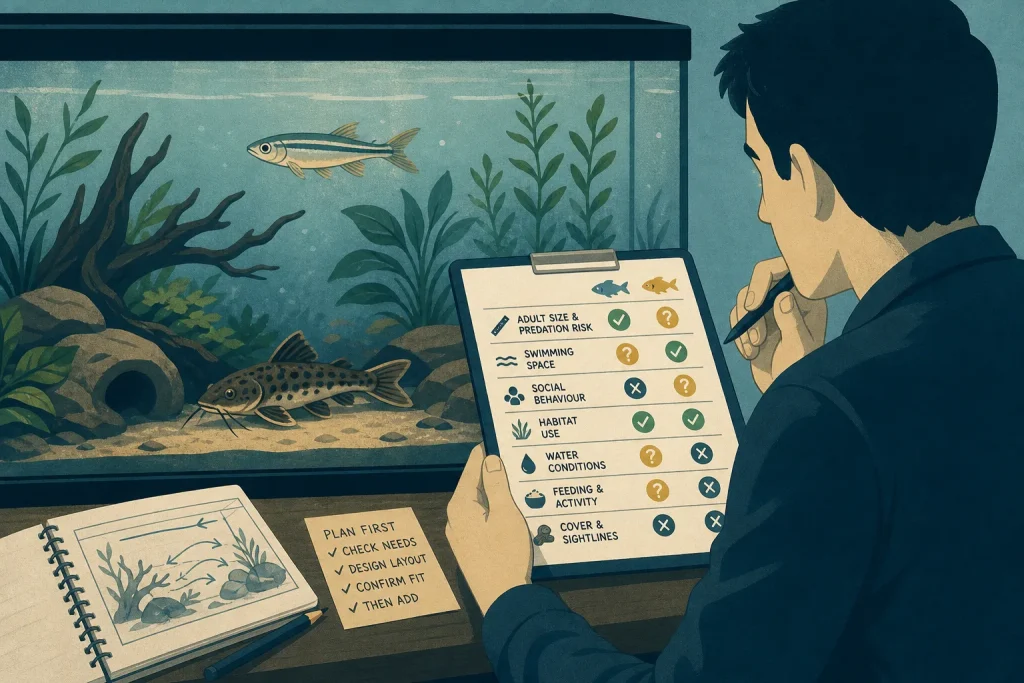
A fish can look calm beside its neighbours in a shop and still be a poor fit for your aquarium. The useful question is whether its adult size, behaviour, social needs and preferred conditions can be accommodated alongside the fish already there. No single clue, including mouth size, settles the matter: species-specific guidance and the particular aquarium both count.
There are three sensible ways to approach the decision: start with the fish already in the tank, plan a community as a whole, or keep one species in a focused setup. Before choosing, compare the essentials below. A fish that cannot meet a basic need in the proposed aquarium is not made suitable by passing other checks.
What should you check before choosing tankmates?
Use this checklist to compare a proposed fish with the animals and conditions already in your aquarium. Look up adult care needs rather than relying on the size or behaviour of a juvenile. If species-specific guidance is unclear, pause and ask an experienced aquarist or aquatic specialist before making a decision.
- Adult size and predation risk: Check the candidate’s likely adult size and the size of the current fish. If a fish could plausibly injure or swallow another, do not treat a simple mouth-size comparison as a verdict: consult reliable guidance on the particular species, their feeding behaviour and the proposed setup. If the risk remains uncertain, do not add them together; seek informed advice or choose a different combination.
- Swimming space: Observe which areas each fish uses and check the aquarium’s usable open water, not just its total volume. If an active swimmer would repeatedly cross another fish’s territory or leave it little room to move, choose a different layout or candidate; if both can use the space without persistent interference, continue checking the other needs.
- Social behaviour: Check whether each species is normally kept alone, in a pair or in a group, and whether it defends a territory. If the required social arrangement would crowd the aquarium or likely provoke persistent conflict, rule out that combination; otherwise, confirm the group size and layout against species-specific care advice.
- Habitat use: Check whether the fish favour the surface, middle water or bottom, and whether their preferred areas overlap. If they compete for the same limited area, consider a different candidate or a layout that genuinely provides separate usable space; if zones differ, still check for behaviour that could drive one fish from its area.
- Water conditions: Compare suitable temperature, pH and hardness ranges using dependable guidance for each species and the aquarium’s established conditions. If those needs conflict, do not try to force a compromise; choose a different combination or a separate suitable setup. If they overlap appropriately, proceed to the behavioural checks.
- Feeding and activity: Check what food each fish needs, when it feeds and whether all residents can reach it. If one fish is likely to be repeatedly chased away or outcompeted, reconsider the pairing or seek species-specific feeding advice; if both can feed without persistent interference, retain the option for further review.
- Cover and sightlines: Check whether safe plants, wood or other structures can offer shelter and break direct lines of sight without blocking swimming room. If an appropriate layout cannot provide a retreat, choose another candidate or setup; if it can, remember that cover helps with habitat design but cannot resolve conflicting water needs or serious incompatibility.
For each item, record a decision: suitable, uncertain or unsuitable. If any essential point is uncertain, wait for better species-specific information rather than treating observation after introduction as a substitute for a sound compatibility decision.
Should you start with the fish already in the tank?
This approach suits keepers with an established aquarium who are considering an addition. Begin with the current fish: note their adult size, usual swimming areas, social arrangement and preferred water conditions. Then compare a candidate against each point, including the space it would use as it matures.
Say you keep a peaceful surface-dwelling fish and are considering a bottom-dwelling species. The different swimming zones sound promising, but that alone does not settle the choice. Check the newcomer’s adult size and temperament against the existing fish, whether the bottom offers suitable shelter, and whether both species can share the established water conditions. If the adult-care information is unclear, leave the tank unchanged and ask an experienced aquarist or aquatic specialist before deciding.
The benefit is that the decision stays tied to actual residents rather than an abstract list of “community fish”. The limitation is that a tank arranged for one species may lack the cover, swimming room or social structure another requires. This approach makes sense only when the existing setup can meet the newcomer’s needs too; it is not a reason to keep adding fish until the aquarium feels full.
Would a planned community suit you better?
A community approach works best when you choose its residents together, before stocking the aquarium. Compare each species against the checklist, then design the layout around their combined needs. Reserve open swimming space for active fish and sheltered areas for those that retreat. Check that plants and decor do not leave a fish without a route away from another.
Imagine you are planning an aquarium with one active mid-water species and a more retiring bottom-dweller. First, check each species’ adult care needs and confirm that their suitable water conditions overlap. Next, check whether the aquarium can provide open swimming room above and sheltered bottom areas without crowding either fish. Then verify that the proposed social arrangements and feeding needs fit the same setup. If all those details are supported by reliable species-specific advice, the combination remains a candidate; if the water needs conflict or the bottom-dweller would have no safe retreat, choose a different combination rather than trying to make the layout do what it cannot.
This option suits someone willing to plan the population and habitat together. Its strength is that likely conflicts can be considered before fish are introduced. Its drawback is that it asks for restraint. If a candidate needs substantially different water conditions or behaviour management from the rest, it may be better suited to another appropriate aquarium than to a forced compromise.
Different tank levels are not a complete compatibility solution. Fish feeding in separate zones may still compete, frighten one another or need conflicting water conditions. Repeatedly rearranging a stable community to accommodate a species whose core needs do not fit is not worth the effort.
When is a single-species setup the better choice?
A focused aquarium can suit a fish with distinctive social, territorial or habitat needs. It allows the space to be arranged around that species rather than balancing several sets of requirements. “Single species” does not necessarily mean one fish: some species need companions of their own kind, so check the appropriate social arrangement before planning the group.
This option can also make sense when a proposed newcomer fails an essential compatibility check. If its adult size, water needs or temperament conflict with those of the residents, a separate suitable setup may be kinder than attempting a compromise. That means providing the appropriate habitat and care for the fish in that aquarium as well. If another setup is not practical, choose a different fish—or leave the current aquarium unchanged.
How do you make the final choice?
Choose the approach that meets every essential need, not the one that allows the longest shopping list. Check adult size and water conditions first, using species-specific information to identify serious conflicts. Then consider swimming room, social behaviour, habitat use and feeding. If the combination appears suitable, confirm that the actual layout offers appropriate shelter and open space for every resident.
A sound decision may be to add a compatible fish, plan a community before stocking, or decline the addition. Keep the species information with your notes and revisit the decision if the fish mature, the group changes or the aquarium is redesigned. Compatibility is not settled by a fish’s calm appearance at the shop; it depends on the needs of the species and the space they will share.