The Light Reaches the Leaves, Not Just the Glass
Tank depth, plant placement and surface cover all change how much light reaches aquarium foliage. A careful observation routine helps you adjust with care instead of relying on a universal schedule.
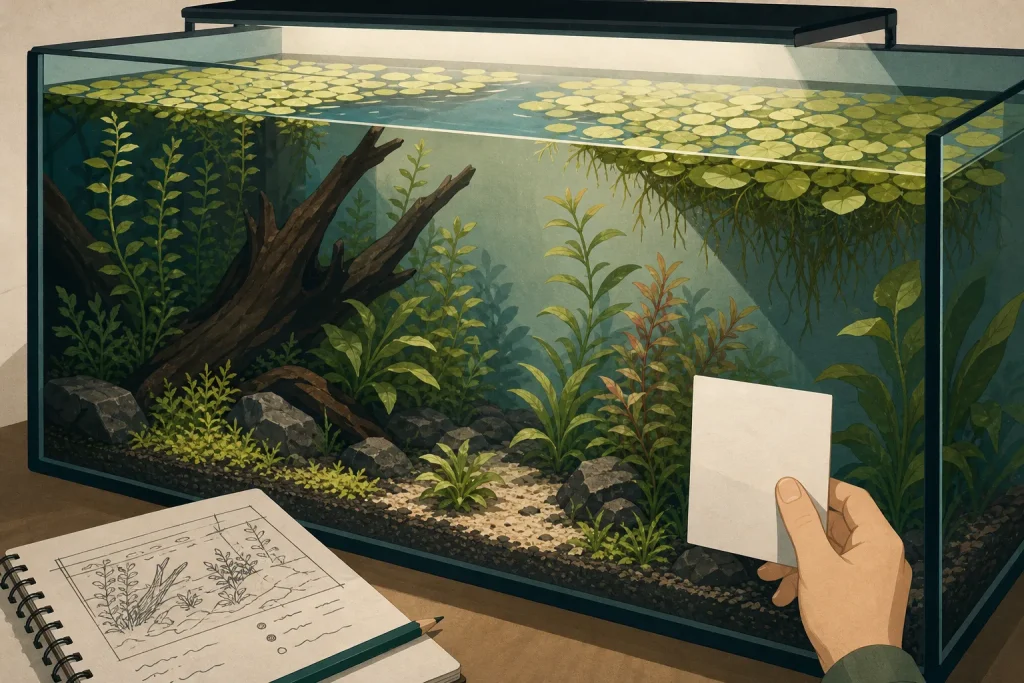
A bright patch on aquarium glass does not tell you how much light reaches a plant at the bottom. Water depth, floating leaves and the plant’s position all change the path from lamp to foliage. To assess the pattern, note what you see before changing anything, then make one small adjustment and give new growth time to develop before judging it.
This is not a schedule for switching a lamp on and off. The right timing depends on the tank, the plants and the light already present in the room. Use a week as a routine for noticing where the light falls; treat plant growth as a slower signal, not a verdict that can be reached after a few days.
What changes between the lamp and the leaves?
A lamp illuminates the aquarium from above, but the tank is not an empty box. Water lies between the surface and submerged foliage; hardscape can cast shadows; and leaves near the surface may shade those below them. A plant at the front can receive a different share of the light from one tucked behind driftwood, even when both sit at the same depth.
Depth is only part of the picture. Suspended debris or tinted water may affect what reaches lower leaves. The lamp’s position matters too. A fixture centred over the tank may leave the ends dimmer, while a low-growing plant beneath a broad floating leaf may remain shaded near the surface.
Do not judge the whole aquarium by a bright reflection. Look at the surfaces the plants occupy: upper faces of leaves, shaded undersides and the ground around their bases. A plant’s condition over time is more useful than a momentary impression of brightness.
What should you record before changing anything?
Begin with observation. With the lamp running as usual, look at the tank from the front and from above. Note which areas are exposed, which are shaded, and whether floating plants form a dense cover or leave open water between their leaves.
Make a simple map in a notebook. Mark the lamp’s position, taller plants, hardscape and patches of surface cover. Beside each plant group, note whether it sits near the surface, in mid-water or close to the substrate. A light meter is not needed for this visual comparison; the aim is to understand the layout before changing it.
If room light reaches one side of the aquarium, note when and where it falls. It can make one section look brighter and complicate comparisons. You are learning which areas receive aquarium light and which also receive light from outside.
- Observation: A plant group sits beneath dense floating leaves. If the shade covers most of its foliage, then consider thinning or moving only some surface cover; otherwise, leave the cover in place and check for another obstruction.
- Observation: A plant near the substrate is shaded by a tall stem. If the stem blocks the light path, then consider repositioning one of the plants; otherwise, do not move them on the basis of depth alone.
- Observation: Similar plants at opposite ends receive visibly different light. If the dimmer end is under a fixture edge or hardscape shadow, then check the fixture position or obstruction; otherwise, record the difference and keep observing.
- Observation: A window brightens one side at certain times. If that daylight varies during your comparisons, then compare the aquarium under its usual lamp conditions at a similar time; otherwise, note the steady room light as part of the setting.
- Observation: One older leaf is yellowing while newer leaves look sound. If the change is limited to that leaf, then avoid treating it as proof of a lighting problem; otherwise, note whether a broader pattern appears across the plant.
- Observation: A surface mat has shifted and now covers a previously open patch. If the change shades the plants below, then restore some open water by moving a portion of the mat; otherwise, leave it alone rather than pursuing uniform brightness.
How can you check where the light lands?
On another day, inspect the tank while the lamp is on and look for consistent patterns. A leaf lit from above may still be shaded by a stem, a neighbouring plant or a floating mat. Compare similar plants in different places rather than comparing broad leaves with fine leaves; their shapes distribute light differently across their surfaces.
For a closer visual comparison, hold plain white card outside the aquarium beside the front glass. Compare the apparent brightness of upper and lower areas. This is a rough reference, not a measurement of plant-usable light. Reflections, room lighting and water colour can mislead the eye.
Keep the aquarium’s normal routine. Note whether a nearby window contributes and whether the lamp’s appearance changes as it warms. A single glance is not enough to call a patch too dark or too bright, especially when daylight varies.
When should you inspect the surface cover?
Check floating plants and overhanging leaves midway through the observation week. Their coverage can shift as they grow or move with the filter’s current. A small open gap can become a broad mat, and a plant that once received direct light may end up beneath several layers of foliage.
Look from above to see whether the cover is even, then from the front to see what it shades below. If a lower plant sits beneath dense floating leaves, the shadow may matter more than its distance from the lamp. An open patch can let light reach a plant that would otherwise sit in shade.
Remove only what you have a reason to remove. If floating plants are healthy and lower plants show no broader signs of trouble, some shade may suit the layout. Clearing the surface simply to make the aquarium look uniformly bright is not worth the effort. Not every leaf needs direct exposure.
What does a plant’s position tell you?
A tall stem can intercept light before it reaches a shorter plant. A plant attached to wood may be shaded by the wood itself. A low-growing plant sits farther from an overhead lamp and can also be obscured by taller foliage.
Use growth and condition as clues, but do not treat one yellowing leaf or one slow week as a verdict on lighting. Older leaves may decline for other reasons, and new plants may take time to adjust. Look for a pattern: whether new growth appears, whether foliage remains in reasonable condition, and whether the same problem occurs in one shaded area or throughout the tank.
Say you have two similar stem plants, one growing well at the back and another with sparse lower growth beneath a floating mat at the front. On the first day, note the front plant’s position and the mat’s coverage. On the second day, move only a small portion of the mat to leave the plant’s top leaves unobstructed; keep the lamp, plant positions and other care unchanged. During the following week, check that the open patch remains and that the plant is not being shaded again. Then leave the arrangement unchanged while several weeks of new growth develop. If that new growth remains less sparse than the older lower stems, keep watching the pattern; if it does not, or the plant’s condition worsens, do not assume more light is the answer. The change may have helped with shading, but it cannot identify every cause of the plant’s condition.
What adjustment is worth trying first?
Choose the smallest change that addresses the pattern you observed. If floating foliage shades a plant, move or thin some of that cover. If a taller plant blocks a lower one, consider repositioning the plants rather than increasing lamp output. If one end is consistently dimmer, check whether the fixture is centred and whether hardscape casts the shadow.
Change one thing at a time. Moving plants, clearing cover and changing the lamp together makes it difficult to tell what altered the light distribution. Keep the rest of the routine steady and make a note of any change to the fixture’s position or setting.
What is not worth the effort is chasing a perfectly even glow across every pane or buying a brighter fixture before checking for simple shadows. More light is not automatically the answer to a plant beneath a thick surface mat. First address what lies between the lamp and that plant.
How long should you wait before judging the result?
Use the first week after an adjustment to check whether the intended change stayed in place: the floating mat has not drifted back, the plant remains exposed, or the fixture no longer sits behind an obvious obstruction. These are immediate observations about the arrangement, not evidence that plant growth has improved.
For growth, wait several weeks before comparing new leaves or stems with the earlier pattern. Keep the lamp routine and other plant-care changes steady during that period where practical, and note any changes you cannot avoid. Compare fresh growth with fresh growth; older damaged leaves may not recover even if the light path improves.
If new growth appears less sparse in the formerly shaded area, that is a reason to keep observing, not proof that light was the only factor. If there is no clear change after several weeks, or the plant’s condition worsens, check other visible causes and avoid making a larger lighting change by default. Plants with different light needs can occupy different positions; the aim is a sensible place for each plant in the light that reaches its leaves.